Se forma con el verbo to be (am/is/are) y un verbo terminado en -ing.
Uso principal: Acciones que pasan ahora mismo o planes fijos del futuro cercano.
Ejemplo: I am eating an apple. Yo estoy comiendo una manzana.
Reglas para agregar “-ing” en Inglés
Para cambiar un verbo normal a presente continuo, usualmente sumamos -ing. Pero hay tres reglas importantes:
- Regla general. Solo agrega -ing.
Play (jugar): playing (jugando).
Listen (escuchar): listening (escuchando).
- Verbos que terminan en “e”. Quita la “e” y agrega -ing.
Dance (bailar): dancing (bailando).
Write (escribir): writing (escribiendo).
- Verbos cortos (Consonante + vocal + consonante). Duplica la última consonante y agrega -ing.
Run (correr): running (corriendo).
Swim (nadar): swimming (nadando).
Estructura gramatical
- Afirmativa: Sujeto + verbo to be + verbo-ing.
She is reading a book. (Ella está leyendo un libro.)
- Negativa: Sujeto + verbo to be + not + verbo-ing.
They are not (aren’t) crying. (Ellos no están llorando.)
- Interrogativa: Verbo to be + sujeto + verbo-ing + ?
Are you studying English? (¿Estás estudiando inglés?)
LEARN MORE
I. Read.
A Rainy Afternoon
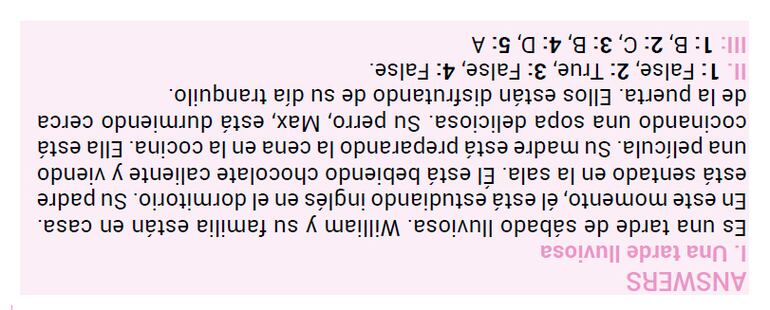
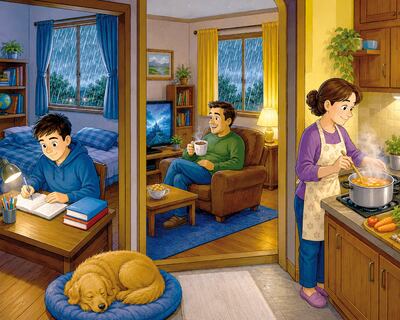
It is a rainy Saturday afternoon. William and his family are staying at home. Right now, he is studying English in the bedroom. His father is sitting in the living room. He is drinking hot chocolate and watching a movie. His mother is making dinner in the kitchen. She is cooking a delicious soup. His dog, Max, is sleeping near the door. They are enjoying their quiet day.
VOCABULARY
1. Rainy: lluvioso.
2. Studying: estudiando.
3. Drinking: bebiendo / tomando.
4. Watching: mirando / viendo.
5. Making: haciendo / preparando.
6. Cooking: cocinando.
7. Sleeping: durmiendo.
8. Near: cerca de.
9. Enjoying: disfrutando.
10. Quiet: tranquilo / silencioso.
Exercises / Ejercicios
I. Traduce la lectura anterior.
____________________________________________________
____________________________________________________
____________________________________________________
____________________________________________________
____________________________________________________
____________________________________________________
II. Responde si las siguientes oraciones son verdaderas (True) o falsas (False):
1. It is a sunny Saturday afternoon. (_____)
2. William is in the bedroom. (_____)
3. His father is drinking coffee. (_____)
4. Max is a cat. (_____)
III. Selecciona la opción correcta para cada pregunta:
1. What is the weather like?
A) It is sunny. B) It is rainy.
C) It is windy. D) It is warm.
2. Where is William’s mother?
A) In the living room. B) In the bedroom.
C) In the kitchen. D) In the garden.
3. What is William studying?
A) Spanish B) English
C) Math D) History
4. ¿Cuál es la estructura correcta para formar una oración afirmativa en Present Continuous?
A. Sujeto + verbo principal + ing.
B. Sujeto + verbo “to be” + verbo en pasado.
C. Verbo “to be” + sujeto + verbo principal.
D. Sujeto + verbo «to be» (am/is/are) + verbo con -ing.
5. Elige la opción que presenta una oración en Present Continuous en forma negativa correctamente.
A. She is not reading a book.
B. She not reading a book.
C. She doesn’t reading a book.
D. She is reading not a book.